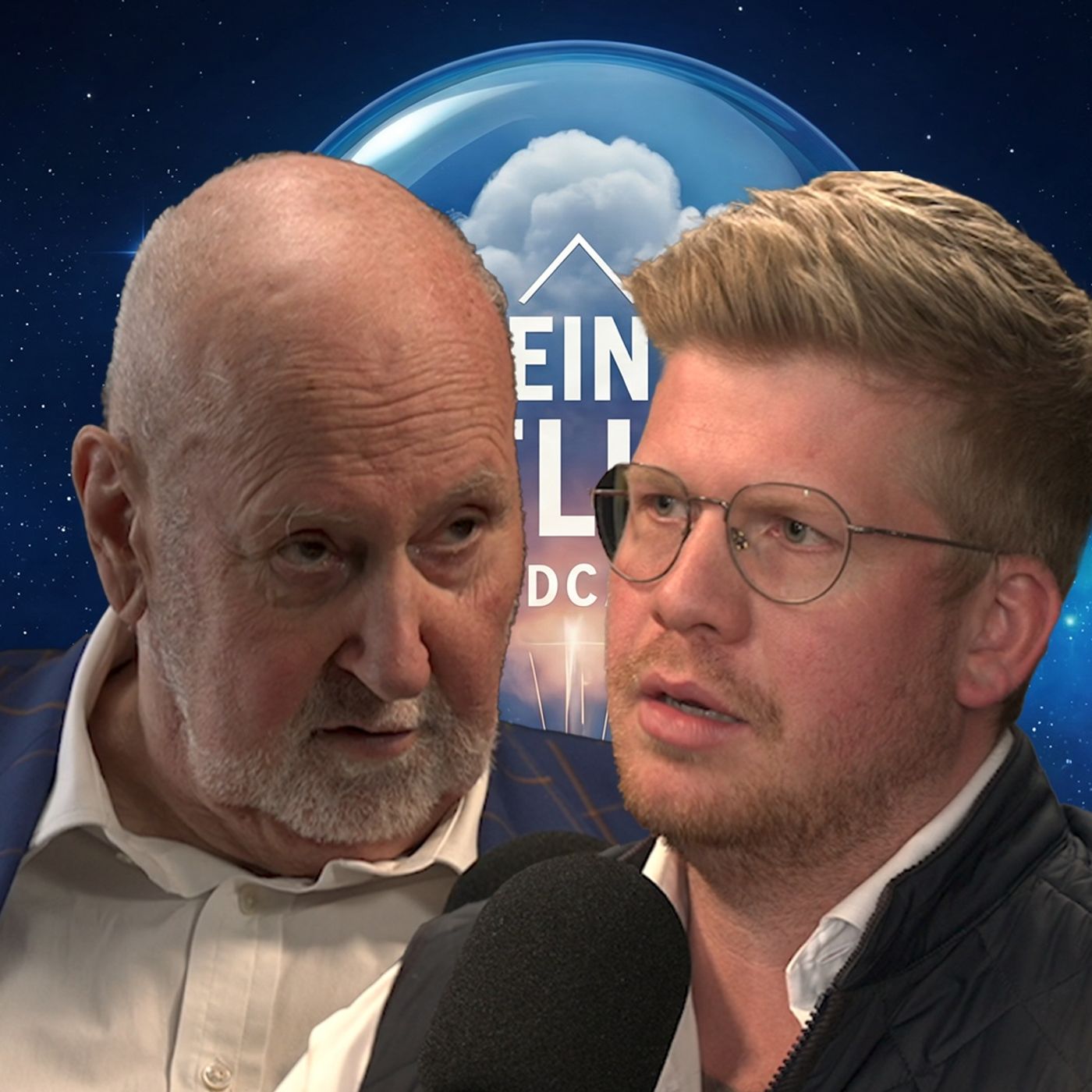
Don't take refuge in the false security of consensus.My own opinion is enough for me and I claim the right to have it defended against any consensus, any majority, anywhere, any place, any time.Karl Pauter Becker, how are you?I'm very well.Very well.So, you are many things, but you are here in Iceland now due to the referendum.You held a lecture yesterday, which was quite weirdly opposed by the university here in Iceland.We might get into that later.But because a lot of my listeners are of a younger generation and they might not be familiar with your long list of achievements.So, how would you, if you give us a quick summary of why you have come to Iceland?How you got familiar with Iceland?How would you describe it?Well, I first had an academic career.I was a professor in Germany.And then I was a professor at the University of St. Gallen in Switzerland.And when the EEA project started, the European Economic Area Project, the Liechtenstein government was looking for an expert.And Liechtenstein is...Not far from St. Gallen.And I became, finally, after a certain procedure, their main advisor.The Liechtensteiners had originally thought that they would be represented by the Swiss in these negotiations.But then they found out that they had their own interests.So that they needed their own, you know, team.And...During all these years, I was their main advisor.I had a whole team of young guns working for this.And at the end, the Swiss voted no to the EEA.And the Liechtensteiners voted yes to the EEA.And then they asked me whether I would like to become their judge on the EFTA court.Although I'm a Swiss citizen, I've never acquired Liechtenstein nationality.And on the 6th of September...1995, I took the oath as their judge.And from then on, you know, I had an Icelandic colleague.It was a very famous man, Thor Williamson, who had also been the president of the Supreme Court here.A professor at the University of Iceland.And I got to know him.And then, as it goes, in a three-members court, you know, you are working very closely together.And I started to come here.And originally, you know, I was rather quiet, you know.If you are the youngster, you start and you look how it goes.And then, after a while, I felt that it was for me also, you know, to speak up.And then I started to come here on a regular basis.And I would meet, you know, other judges here.Icelandic judges.I visited courts.I gave lectures.I gave lectures at all four universities.Also in Bifröst, in Akureyri, and at Reykjavík University, when it was established.And I spoke many times at the State University of Iceland.Also in the festivities hall.At this time, I very much enjoyed being here.I traveled the whole country.In particular, with my good friend, Þorgir Þurvíksson,who was then the second Icelandic judge and later became the Chief Justice of Iceland.I have a lot of friends here.And I tremendously enjoyed my time here every time I was here.Sometimes my wife accompanied me.And we would go to Akureyri.We would go to Mívatn.We would visit Husavík.We would visit the Westman Islands.Or by plane.And go to the West.And so, Akureyri started.I'm quite familiar with this country.I don't speak the language.That's too difficult for me.Yeah, I can imagine.Yeah, you've traveled quite extensively.More than some Icelandic people even.If you went to the Westfjords even.Yes.But you have grown increasingly doubtful about the path that the EU has been taking.And you, of course, played a big role here in Iceland where you put us on a path of a very different realitywith your impact on the ISAFE agreement that we ended up declining.Can you give us a back story about those proceedings?Well, ISAFE, I think, came in in the year 2011.I had been president of the court for...For eight years.And I felt that this small court had quite a strong position.In Luxembourg, we were only three.And the Court of Justice of the European Union, much, much bigger.They are located in fancy buildings, whereas we were in a modest basement.But I think our case law was appreciated by the other side.Even...Even when we didn't follow them, the essential thing is that you give good reasons.And we tried to do that.And I closely worked with important Icelanders.I mentioned them yesterday during my lecture, Þorgeir Erlíksson, Benedikt Borgason, who wasan ad hoc judge, but sat in a very important case.And then, I mean, when it comes to academia, I became a very good friend of...Stefan Maur Stefansson.And Skúri Magnússon was my registrar, wrote a lot, wrote very constructively, but alsovery clearly, against those who wanted to undermine the EFTA court, and made then afantastic career here in the country, you know, became president of the Reykjavík districtcourt, parliamentary ombudsman, and now is sitting on the Supreme Court.Mm-hmm.And, you know, in a way, it was almost natural that the two little ones went along well.You know, Norway was the superpower of the EFTA pillar, and Iceland much smaller, andLiechtenstein even much smaller.Although I, as a Swiss citizen, never had a problem, you know, to confront also thosewho thought that they were more important.Mm-hmm.And as mentioned yesterday in your lecture, we are...We Icelanders will be taking on a referendum on the 29th of August, and a lot of peoplewill be voting yes, a lot of people will be voting no, according to opinion polls.Now, what I'm wondering, because you mentioned in your lecture about a democratic deficit,one of the main arguments with regards to this referendum is that if we Icelanders arewilling to be... become a member of the EFTA, then we are going to have a referendum.Mm-hmm.And if we are going to be a member of the EU, we will get a seat at the table.We will have even a larger impact compared to our population, because we will have six,which is the minimum, of course.Well, only the parliament.Yes, the parliament.Hundreds and hundreds of people.But that's the sell.That's the sell that...I know....is the main argument for us to be, because we are taking in all of these laws.We are taking on all of these rules.Yes.Why not being able to...Yes....distribute?Because if we are able to get our opinions across, we'll be able to influence how thevotes will be cast.Yes.Well, I don't deny that there is this democratic deficit.It has been there from the very beginning, but, I mean, the way it is presented now isgrossly exaggerated.I mean, you are 400,000 people, and, you know, this argument, the seat at the table, theseat at the table is a classical textbook argument, or you may also call it an armchairprofessor argument.I mean, I have quoted yesterday Giorgia Meloni, the Italian prime minister.Italy is a major power in the European Union, was a founding member state, and is, you know,basically number three after the Brexit, politically speaking.And...Meloni complained bitterly about the way Mrs. von der Leyen was re-nominated justby the French and the Germans.And she spoke of backdoor politics and shady things going on and oligarchs, you know, callingthe shots.I mean, you know, a seat on the table sounds good, but when it comes to real importantstuff, that shouldn't be...It shouldn't be exaggerated.On top of that, I mean, the seat on the table wouldn't come for free.I mean, right now, you have a very favorable situation when it comes to the common policiesbecause the EFTA states are exempt from the common policies.That means fisheries, agriculture, foreign trade, foreign policy, currency.You are out of this.And if you join...Then you get...You get this seat at the table, which is probably not so important, but you have togive up your freedom with regard to the common policies.And then these people say, oh, we can negotiate an exemption.Well, this is an open question, whether you can negotiate it.Certainly right now, you know, the European Union makes allegations that they are preparedto grant this.But once you have voted yes on the 29th of August, who knows?How far?How far these exemptions will go.And one thing is clear, you cannot get all the exemptions, you know.You cannot conclude an accession treaty and say we don't want to have fisheries, we don'twant to have agriculture and so on.Yeah.And also the main characters pushing this agenda are very shy to agreeing that we shouldtry and get exemptions.When it's mentioned...Yes.Like, go around the question and it's quite interesting.I will be getting Þorgjörður Katrinn here in six days, so we'll see how it comes topath when I try and push on that.But you spoke also about path dependency.Yes.And I want to link in another question to that because a lot of people say, well, we'rejust going to take a look at what is on offer.We've been talking about this for decades now.Why not close this question once and for all by saying yes now and no later on?Because we have been discussing this, this is, according to them, the only obvious solutionfor us to be able to get a currency that is more stable than the Icelandic krona.Why not take a look at what is on offer?Let me start with the currency.I'm Swiss.And since the currency was introduced, it has lost, I don't know, 65 percent of itsvalue vis-à-vis the Swiss franc.This is not a strong currency.This is a very weak currency.You may remember how strong the German mark was.And now this euro, you know, it reminds me almost of the Italian lira at the time.So I'm not sure that this is a good argument.I'm not an economist.I don't go into details.But those who claim this, they don't go into the details neither.It's just a political contention which they make here.I generally feel that their arguments are kind of, you know, almost soft, not strongarguments.It's very political, very emotional.They come with Donald Trump.They come with the currency.They say we finally have to settle this.Why must us be settled right now?Is this personal?Is it personal ambition of certain people here?I mean, Iceland is in good shape.I have looked at the latest figures.Iceland is a very wealthy country and has recovered perfectly from the ISAF crisis orthe banking crisis, not least because you were able to devaluate the corona.If you compare that with what happened in Ireland.You would be able to devaluate the corona.You were much better off.So that doesn't convince me, I have to say.No, you raise an interesting point because this is something that has annoyed me slightlybecause we are in a better shape than Europe.And then the people pushing this come to me and say, well, that is an obvious case inpoint for us since we're able now to negotiate a much stronger deal because if the EuropeanUnion is in a such a bad place and we have other countries that are not in as good ofa shape coming in as well, we'll be able to negotiate a much better deal since we're ina such great shape.Yes.Well, that's a purely theoretical assumption, you know.I mean, when it comes to fisheries, you have the Spaniards, you have the Danes, you haveothers who will be very reluctant.Yeah.You know, to grant a broad exemption here.I have spent every summer in Spain for decades, always at the Basque coast.And I have seen how little fish they have left there.And I have also seen what they did when Great Britain was in the European Union.I've seen with my own eyes how Spanish trucks took the whole Scottish lobster.Yeah.And, you know, they will, the Spaniards are not so strong economically, but they alsohave a lot of pride, you know, they used to be a world power and they wouldn't careabout whether you are a bit stronger or in better shape.I think that's, again, a rather theoretical argument.You could also turn it around and say, why should we negotiate if we have done so wellnow?Yeah.Yeah.Yeah.There is a...Because your profession is obviously, and your expertise, is with regard to the judicialsystem.And what I'm wondering, because I've never been a strong advocate for a no with regardsto the EU until maybe two, three years back, or two years back, pretty much exact, whenthe Draghi report came out.And I've been doing...I've been doing a six-episode series about the Draghi report because I think there isa very important variable that things are not as good as they might be today, or thefuture of the European Union is quite different than the past.One of the most important things in the report is that they have a very hard time takingon the rule-based system.And...And...And...And...And...And...And...And...And...And...And...And...And...And...And...And...And...And...And...And...And...And...And...And...And...And...And...Why is it so hard for the European Union to take on this increasingly worrisome situation?Well, you know, bureaucracies don't give up power.They have once acquired.I mean, it may be that politicians are able, you know, to impose a certain change, but bureaucrats themselves, they would never give up what they have gained.And what I see in the European Union, I have lived in the European Union for 30 years now, in Luxembourg, very close to the German border, very close to the French border, is that it becomes more and more bureaucratic.And I know the Draghi report, I don't think that's going to make a big change.If you see...When we take technology, you know, Europe clearly is way back the United States and back of China.And their answer is regulation, you know, controlling the internet and going against hate speech and all sorts of fuzzy concepts.And then we even come into the area of freedom of speech.You know, Europe in the meantime, not only among...The American Republicans, but also in other jurisdictions, the European Union has the reputation of not being in favor of free speech anymore.I mean, we have seen what happened in July in the European Parliament when they tricked through this chat control with a very questionable procedure.I would call it abuse of procedure, that they waited until, you know, the vacation had started.People were not there anymore.They tricked it through.And chat control in itself is problematic, but the procedure is even worse.Trying to push it through five times, I think, or three times at least prior, and then waiting until everyone is on vacation and then push it through.Yes, this is against good faith.And this is against all the values they are continuously invoking.Yes, this is...And I'm increasingly worried that because...There are...A guy from Westfjörð, since you've been there, they complain a lot about not having as much of an impact through parliament.And they argue that all of the infrastructure is not on hand because parliament members don't really care about what happens in the Westfjörðs.And I was in Westfjörðs a couple of weeks back and one of the guys told me that,I don't agree with everything that you say.However, I will be...I will be voting no because I think that if we join, Iceland will become the Westfjörðs of the European Union.And I thought that is a great point because we are a population of 400,000.And of course, they will be very adamant to saying that we'll have all sorts of resolutions and solutions for your economy.And we'll have all sorts of solutions and special...Exemption and we'll have everything for you.But as soon as we get in, that is probably not something that they will have to uphold.Unless we get regulated exemptions, which is obviously probably not on the table.So, because you mentioned your doubts about the European Union, you were once an advocate for Swiss joining the EU.Mm-hmm.When did that change?And has your...Like, has it gone on and off?Have your ideas changed throughout the years?Yes, they have.Yes, I was...I wrote that in prominent newspapers in Switzerland that Switzerland had to join the European Union.That was in the mid-90s when the single market had been completed.Ethereum.At least.And when there were strong leaders, Jacques Delors, you know, the French president of the commission.And then I became a judge and we moved from Geneva to Luxembourg, close to our big brother, Court of Justice of the European Union.And then we actually profited enormously from the European Union.And then I became a judge and we moved from Geneva to Luxembourg, close to our big brother, Court of Justice of the European Union.And then I became a judge and we moved from Geneva to Luxembourg, close to our big brother, Court of Justice of the European Union.Because in this small EFTA pillar, there was not a real equilibrium.The Norwegians were very strong.And the Norwegians were good and, you know, protected their interests.And in the court cases, the European Commission always would submit observations and would plead at the oral hearing.And there was a unity of doctrine.You could feel that there was a head of the legal service, you know, who was in charge of this, was a big brain, academically educated and so on.And then this legal service became more and more political.And you saw the names of these people and you googled their CV and you saw that they were, you know, from a bureaucratic career.And at the same time, the Commission itself started to claim that they wanted to be political.The first one to spell this out explicitly was the Luxembourger Jean-Claude Juncker, who, when he started, said, I want to have a political commission.And the political commission goes per definition at the expense of the law to a certain extent.Because politics is not the same as law.And then von der Leyen said, I want to have a geopolitical commission.So the Commission more and more, you know, wanted to be the government of the European Union.But then there is also the Council.That's not so clear how they work together.And you may remember these strange scenes when Mrs. von der Leyen and the president of the Council were in Turkey and the question was who gets a seat and so on.And so there is a power struggle going on there.And the way I have seen it is that the Commission has become more and more political.And that's a good development.Let's take a sidestep slightly because I was very intrigued by the conversation we were having right before we started recording.And you mentioned South America.You will be in Argentina in a few days.And the fast development of...Countries that we have been, I'm not going to say looked down on, but there is an increasing pace to which better living standards, for instance, in India.I've been to India three times, spent roughly around a year of my life there, and I went there in 2012 and then 2015 and then 2018.And every time I went again, it was so interesting to see how fast the development was in India.And every time I went again, it was so interesting to see how fast the development was in India.And every time I went again, it was so interesting to see how fast the development was in India.Now, we have a free trade agreement with India.Now, the European has that as well.We, of course, have a free trade agreement with China, which the European does not have.And I mention this because you were mentioning South America.And you were mentioning it with regards to the fast pace of better living standards.Of course, they have their problems.Mexico has their problems.Colombia has their problems.All of these states have their problems.Javier Millet is, of course, a very interesting variable nowadays.But one of the main, or not the main thing, but one of the more important variables annoying me is that because we are able to get free trade agreements quite more easily because we don't have so many interests that are in the European Union.Yes.What do you think about...What do you think about us in this context compared to if we were in the European Union?Yeah, well, you would lose this sovereignty.You would be part of the common trade policy.And I remember very well when you achieved this free trade agreement with China.It was a big, big victory also symbolically, politically, quite clearly.The other EFTA country which has a free trade agreement with China is Switzerland.And you would have to have to give this up, you know, if you join the European Union.As far as Latin America is concerned, I always had a weakness for Latin America because I love Spain, I love Italy.Argentina is, you know, very much Italian.I was for a long time a visiting professor at the University of Texas.And I had my family with me then and I would always add a couple of weeks in Mexico afterwards.And then I had in my cabinet, as a policy in my cabinet, I took mostly legal secretaries from the European Unionbecause that was good for homogeneity.I also had a Russian girl once.I had an American and so on.And I once had a German-Peruvian double citizen.And this chap started to talk, you know, about Latin America.And then it was able to establish a contact with the Tribunal de Justicia de la Comunidad Andina.That is also a clone of the ECJ as we are.And this tribunal is responsible.It is responsible for the Andean community that is Ecuador, Peru, Colombia and Bolivia.And we met these people, these judges.I was in Quito, in Ecuador.I was in Lima, in Peru.They came over to Luxembourg.And we had the plan to launch an EEA type of model for Latin America.Because in a similar way, we had the plan to launch an EEA type of model for Latin America.Because in a similar way, we had the plan to launch an EEA type of model for Latin America.But in a similar way, as in Europe, they have two pillars.But in a similar way, as in Europe, they have two pillars.We here have the EU pillar and the EFTA pillar.And they have Mercosur and the Andean community.And in their case, it would even have been easier, you know, to establish such an agreement.And in their case, it would even have been easier, you know, to establish such an agreement.Because there is not one clearly dominating.Although the Mercosur is bigger, but the Andean community is also important.Um-hum.And the judicial systems are a bit different, but this would have been a possibility and EFTA could have exported its model to Latin America.When I left the court, unfortunately nobody continued this, but I will actually in two days, I will speak to Argentinian lawyers, unfortunately only via the internet.I will no more be able to fulfill my last dream to ski in Bariloche because of my metal knee, but still I hope to get back to Latin America.I was interested.I was in Chile, I was in Peru, I was in Ecuador and these people are, you know, rather close to Europe also because of the Christian faith they are having.Yeah, this is something that I have been trying to understand because one of the arguments saying that we ought to join the European Union is that, well, the world is increasingly dangerous.And,and we see that Trump is obviously, he takes erratic and sporadic decisions and we are no longer able to put our faith in him.He puts on tolls, 15% on some people, other percentages on other people and we need to look at other directions.Hence, we are able to look left or right.And I've always thought that this,this argument is quite weak because at an increasing pace, a lot of these African countries, a lot of these Latin American countries are creating free trade agreements all over the world.Hence, I think that we'd be in a better position being able to be swift and quick creating these circumstances where we are able to create free trade agreements with these countries.Because the big VLCC, the suppliers are able to travel further than in history.Hence, we ought to be really quick on our feet rather than joining the EU, which is not in as of a good shape.Well, I agree.And as far as Donald Trump is concerned, I'm not going to defend him.But he will not be.He will not be there forever.And to make such a decision under the impression of Donald Trump is not the right thing to do, in my view.In particular, because, I mean, when we talk about Greenland, I had a slide which I made myself with artificial intelligence where Trump is grabbing Greenland.I mean, that's not going to happen.And even if he would try to do that, the European Union is not a military power.The European Union itself is still depending on American capabilities.And a little bit of political protection wouldn't really help you in this situation.So, I think as far as security is concerned, you have to stick to NATO and you have to stick to the defense agreement with the United States.I have never heard that those who...Those who are in favor of EU membership would terminate the defense agreement.It's not my field, but I read the newspapers.And so, at the end of the day, I tend to agree a little bit with what I read, what diplomats said at the last G7 meeting.I think that Donald Trump reminds them more and more of the boy who goes to the forest and always cries,the wolf comes, the wolf comes.At the end...People don't believe it anymore.I think that's...It's called tackle.Yeah.Trump always chickens out.Yeah.Yeah.At the end of the day, he talks a lot and then he chickens out.And, you know, I would say this is a rather artificial argument.Clearly, it's emotional because it's easy to scare people, but Icelanders are not easily scared.You are Vikings and I think you can recognize...What's behind this.Well, we'll see you on the 29th.So, you talked about...Let's move again towards path dependency because you spoke yesterday about how the practical issue of us joining the EU.If you can elaborate on that, what do you think the practical...Because a lot of people know, well, we'll send some people and we'll negotiate and if you'd like the agreement, you will vote on that.But in your view and given your experience working within the system, how do you perceive the proceedings of the development?Yes.Well, I said yesterday night I was never a negotiator, but I have seen a little bit how it goes.And when I spoke about path dependency, I meant that once this first vote would be positive for the government,the machinery of the European Union would start.What is the machinery? That is what I'm trying to get out of you.Well, you know, they have these networks of people who talk and write.They have professors, they have their own universities or university institutes in Bruges, for instance, in Belgium or in Poland or in Fiesole near Florence.And then they are...They are able to describe positions as almost inevitable.You know, I said yesterday, they argue, Tina, there is no alternative.They depict those who are skeptical as right-wingers or backwards or, you know, ridicule them.Whereas those who are in favor, they are called, you know, modern and responsible and open.It's this kind of spin doctors acting here and framing plays an important role here, you know.I'm flabbergasted that the European Union talks on and on about rule of law, about democracy, about values, you name it.And if you look a bit closer, it's not so great when it comes to democracy.And even when it comes to the rule of law, the commission writes reports on whether the member states comply with the rule of law.But nobody writes a report on whether the commission complies with the rule of law.So, I mean, this machinery would start and it has already started.I mentioned this in my lecture yesterday.I read that the former Belgian prime minister, Verhofstadt, he said,Icelanders must join, they must come to us.We are the...We are the empire of the good.Can you imagine that you make such a statement?I would be reluctant to talk like that, you know.And particularly in this situation where the two leading nations, Germany and France, are in huge, huge difficulties.And the Austrian foreign minister even said that she sees a new world power coming up.You know, the German philosopher, Sloterdijk, one of the big...One of the big brains in Germany, he said European Union is an association of former empires and former colonial masters.And they are trying to get a form of organization again.But you still can't feel this way of thinking.Speaking about reluctancy, because there have been also features coming out of the European Union that will leave one flabbergasted.And it almost sounds...I'm making some of it up.Because Von der Leyen, of course, has mentioned that they are not going to endure another Hungarian crisis.Because the Hungarians have been having the veto vote.And hence, the European Union couldn't push a certain agenda with regards to the refugee crisis.Which was not a crisis, according to the EU, when Angela Merkel was in charge.Hmm.And it's, of course, obvious now to everyone that it was a crisis then and it is a crisis now.And now, they have, again, during the summertime, which I don't know if it's a variable with regards to having people on vacation or not.But now, the European Union will be taking into account the fair share.Where refugees will be able to be split up to different countries.Within the EU.And the EU members have to take in the refugees to...So, Cyprus and Spain, Italy will not endure all of it coming over by the coastline.And we, of course, can pay 20,000 euros to not having to endure that.But then, we'll have to pay 20,000 euros per applicant.This is...To many people...To many people...Sounds insane.And as I mentioned, some of the things that are coming out of the European Union are, quite frankly, something that sounds like I'm making it up.You mentioned this not entirely in its...Or not the point in its entirety.But you mentioned that the crisis with regards to security and the European having a trouble...Having troubles with taking on this issue.Could you elaborate on that?Or give me your thoughts on what I was just mentioning?Well, you know, generally speaking, I think that Europeans have a bad conscience because of colonialism.That is understandable and that is also basically decent.You know, that you realize that colonialism was a terrible thing.But based on this, they are hardly able to develop...A reasonable migration policy.I can see that in Germany.I'm living very close to the German border.I have a German wife.I was a professor in Germany for a number of years.Whenever a jihadist attack occurs in Germany, somebody is killed.Or several people are killed.Or severely wounded and so on.It's always like a ritual.You know, politicians say, oh, this is terrible.We feel with the victims and so on.And then it's over.We need to stick together and stuff like that.Yes, we started that.And we won't accept that our liberal way of life is changed and so on.And they don't do anything about it.And I don't believe anymore that this can be changed.No matter...Now, to blame the Hungarians for it is a little bit interesting, I would say.If you look what is going on in Spain,or in these two places in Northern Africa,Deuta and Melilla.I mean, to blame that on the Hungarians is a little bit cheap.Yeah.Yeah, it's...And of course, this is something that has become more of a hot topic here in Iceland.Because we've had our instances, not a terror attack,but we've had a lot of things on the news with regards to people with refugees,and people are increasingly getting worriedthat we are turning at least towards the same direction as Sweden.And...Yeah, you have Sweden as an example that's even worse than Germany.Yeah, which at the same time, when I was mentioning this in 2015,around that time, when somebody mentioned it,people were like, no, no, we don't have any trouble with it.But of course, the house was on fire already.But broader picture,how do you perceive the future of the European Union?If you would try and paint a picture of how it will look like in 10 years?No.I know it's an unanswerable question.Yes.But give it a shot.Well, I was asked this question yesterday,and I said I'm not good at making prognoses.I made two positive prognoses.I mean, positive in the sense that I was right.I predicted and I even won money the election of Donald Trump,the first election of Donald Trump,when everybody was convinced that Hillary would make it.I have this Texas experience,and I had seen the mistakes Hillary made,and I was quite sure that she would lose, and she lost.And I also predicted Brexit.Most people said, this is ridiculous,this is never going to happen, and it happened.But otherwise, you know,I am reluctant to make a prediction with regard to the European Union.What I want to say is the following.I cannot see why the European Union is so keen to lure Iceland into their system.They should also realize that the EEA is beneficial for thembecause the EEA, as small as it is,it guarantees a certain moderate systemic competition.We have seen that in ISAF.Our ISAF judgment was based on other economic thinkingthan what the European Union has been doing,saving all the banks, you know.And that's probably a healthy thing.And there's a second issue here.The EEA structure may be needed one day,for the British.The British may come to the solutionthat they would like to have preferential accessto the single market again,at least in the most important areas.But they would not like, you know,to be subject to the Court of Justice of the European Unionwhere they couldn't have a judge.So they would take the EFTA Courtand have a judge on the EFTA Court.And the same with Switzerland.The Swiss have now signeda number of treaties with the European Unionwhich are very, very unequal.You know, their government has acceptedthe Court of Justice of the European Union.And whether this will pass in the referendum,a referendum to be held either next year or in 28,is an open question.So the Swiss may also need the EEA structure.And a country like Turkey may need the EEA structureat the end of the day.Turkey, which officially is an EU accession candidate.So I think it's short-sighted, you know,to push for Icelandic membershipjust out of, I don't know,the hunger for power.I don't know exactly what motivatesthe European Commission.I mean, they have the Icelandersvery close via the EEA agreement.The Icelanders are very close to the rest of Europewith the exception of Switzerland,they are NATO.And I cannot see why this is so urgent now.Not at all.I think it's artificial.It's made up.Yeah.I don't know.I don't know if the urgency comes fromthe European Union or if it comes from Iceland.No, no.It comes from Iceland, I think.I think so.You know, last time it was the consequenceof the downfall of the banks.That was clearly the attempt, you know,to get the big brother.The big brother who would save you.But the same big brother wanted an outcomeof the Iceland judgment,which probably would have meantsovereign bankruptcy,state bankruptcy.And this time,my impression is,you know,as a Swiss,I have to be a little bit cautious,although I have been invited bythe foreign committee of the Altingito comment.And my impression is thatit is linked to individuals,powerful individuals in this countrywho have this idea thatIceland must be part of a bigger thing.And I don't want to say more.It is normal that people have personal ambitions.I also had personal ambitions.Yeah.It's so funny becausethe conversation regarding the topicis pretty much thatthe elite wants the yesand then the yeses say,no, no, the elites want the no.So it's quiet andnobody knows what is heading up.So let's actually,let's finish on Brexit becausethat has been one of the arguments that,well, look at Brexit.Look at how bad of a shapethe Brits are now.Yes.Since they left the European Union.They are in a terrible shapewhich is an obvious signthat we ought to join the European Union.I have answered it like thisbecause we're in a great shapeand if we would want toleave the European Unionwe'll be probably in the same shape as Britain.So I don't get that pointbut it is thereand it's made.And what,what do you have to say about that?That the Brexit is such an obvious signthat the Icelanders ought to joinbecause we ought not to bein the same situation as the Brits.This is comparing apples and bananasand I can tell you thatfor two years I wasan advisor to the British Parliamentboth houses.Under what prime ministers?May.Yeah.After,May and Boris Johnson.Yeah.And I also advised the regional governmentsin Scotlandin Walesand in Northern Ireland.And I always told themif you want to stay in the single marketyou join the EAin one way or the other.The problem was free movement of persons.And then at the endthey left the single marketand they now have thisfree trade agreementwith the European Union.Now this cannot be comparedto the Icelandic situation.First of all,yes, the Brits haveblown Brexit to a certain extentbut it still can be fixed.And secondly,if people say look athow badlythe Brits are doing,how badly are the Germans doing?How badly are the French doing?I think the Brits are still better offthan the Germans and the French.How come?Yeah, because they have different structuresin my view.Britain is an old democracy.Britain and Switzerland are the twoold democracies in Europe.And I said yesterdayIceland has also elementsof democracy.What has not been sufficientlyyou know,looked into was the rolethat was playedby the former presidentJameson during the ISAF crisiswhen he called for these two referenda.And you know,it's an interesting question iswho invests where?And I know the legal businessand I can see thatthe law firms in Great Britainthey hire a lot of people.That means they are expectingadditional business.Otherwise they wouldn't do that.And so I think it'sa weak argument.Let's finishon this final question becauseÓlaur Ragnar mentionedyesterdaythat he found it very interestingthat the Lisbon Treatyhad not come upin the conversation.What are your thoughts on that?The Lisbon Treaty.Maybe a quick summary of what it isfor the younger listeners.Well, the Lisbon Treatywas agreed afterthe Constitutional Treatyhad beenrejected in Franceand in the Netherlands.It was a huge step forwardyou know, in the directionof deeper integration.Andhe is right,you know,a lot of things apparentlyhave not been addressedand those who are in favourof EU membershipthey stick to theseemotional argumentssitting at the tableand in particular Donald Trump.I haven't heard much moreof this.I cannot saythat the Lisbon Treaty is bad.I mean it was agreedobviously Ólaur Ragnarsees it in a morecritical way.I see morethat you would lose ESAyou would lose the EFTA Courtyou would losesovereignty in thefields of common policiesandyou would gain little.You know, ifyou put that on a balancein my view it's rather clear.You are in a different situation than the Swiss.You are part of the single marketand you knowthe biggest achievement of the EFTA statesat the time in 1992 wasthat the EFTA Courthas the right to giveinterpretation to single market lawand nobody can correct it.There is no appeal to the Court of Justiceof the European Union.The judgement stands. Full stop.There are certain obligations to be homogeneousbut these are behaviouralobligations not structuralobligations.No judgement of the EFTA Court can be appealed.When the EFTA Court ruledin ISAFthe European Union was unhappyHer Majesty's governmentwas unhappythe Dutch government was unhappybut they couldn't do anything about itand you shouldn't forget thatyou are the country which has experiencedthe strength of the EFTA pillarthe most important countryin the EEAbecause you hadthe bad luck to have thisfinancial crisisand you shouldn't forget that.No. People debate about whether it was bad luckor bad decision makingbut we are not going to get into all of that.Not by the EFTA Court.No, I am talking about thedevelopment preceding it.Karlvery enjoyableyou are afun lad to sit down with.Karl Bautenbakerthank you so much for comingand until next timeand have a safe trip home.Thank you very much. It has been my pleasure.Thank you very much.